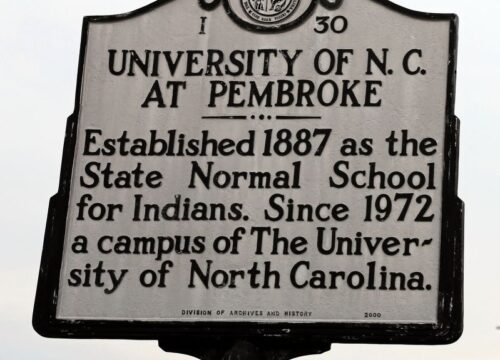
Pembroke is a small town in southeastern North Carolina, but it has an outsized importance in the history of the Lumbee people and Native American education in the United States. Today it serves as the cultural and political center of the Lumbee Tribe of North Carolina and is home to University of North Carolina at Pembroke.
Indigenous roots
Long before the town existed, the area along the Lumber (Lumbee) River was inhabited by Indigenous peoples. The ancestors of today’s Lumbee people lived in and around the region for centuries, drawing together descendants of several Native communities that survived colonization, disease, warfare, and displacement in the Carolinas.
From Scuffletown to Pembroke
The community that became Pembroke was once commonly known as “Scuffletown,” a largely Native settlement in Robeson County. The modern town emerged in the late 1800s when railroad development brought economic growth to the area. A railroad station was established at Campbell’s Mill, and land was laid out for a new town. The community was incorporated in 1895 and named Pembroke after railroad official Pembroke Jones.
A center of Lumbee life
By the early twentieth century, Pembroke had become the principal commercial and social center for the Lumbee people. Unlike many Southern towns during the Jim Crow era, Pembroke’s large Native population created a distinctive social environment. Lumbee residents increasingly challenged white political control, and after years of activism the town elected its first Lumbee mayor in 1947.
Pembroke Tourism Authority
The duties of the Board are as follows:
To assist in formulating a Travel and Tourism program for the Town.
To serve the Town in an advisory capacity in the formulation of a Travel and Tourism budget and policy.
Education and the birth of UNC Pembroke
One of the most important developments in Pembroke’s history was the creation of a school for Native Americans. In 1887, North Carolina established the Croatan Normal School to train teachers for Native communities. The institution moved to Pembroke in 1909 and evolved through several names before becoming today’s University of North Carolina at Pembroke. It is recognized as North Carolina’s Historically American Indian University.
The Lumbee struggle for recognition
Pembroke has also been the headquarters of the Lumbee people’s long effort to gain official recognition. North Carolina recognized the tribe in 1885, and Congress acknowledged the tribe in 1956, though with significant limitations. The tribe continued pursuing full federal recognition for decades, finally receiving it 2025, making them the 575 Federally Recognized Tibe in the United States. The tribal government and headquarters remain based in Pembroke, making the town the symbolic heart of Lumbee identity and governance.
Pembroke today
Modern Pembroke remains a small town, but it is known throughout North Carolina for its Native American heritage, university, and cultural events such as Lumbee Homecoming, which draws Lumbee families from across the country back to their ancestral homeland each year.
In one sentence: Pembroke grew from a railroad town into the cultural, educational, and political center of the Lumbee people, making it one of the most important Native American communities in the eastern United States.